
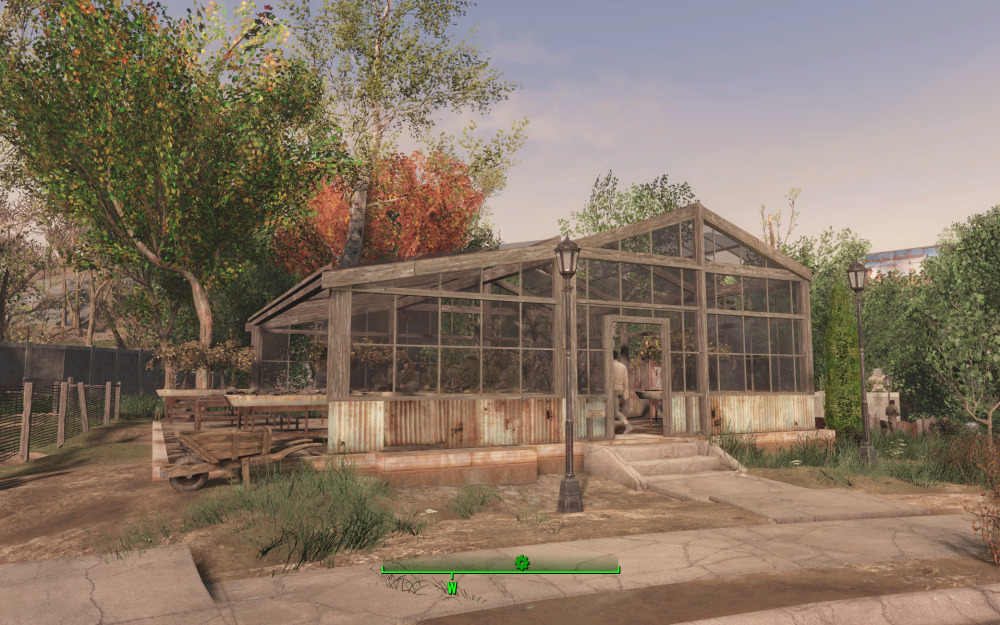
^

s.wbones

AUTHOR'S INTERLUDE: Agriculture

Okay so on a player level, I really enjoy the settlement system in Fallout 4. Game design? Yes. Exactly my shit.

On an intellectual level, there's a lot of problems with it - especially as I sit down to write this fic. So many questions. Like, nobody wants to farm, right? Farming fuckin' sucks. It's thankless, back-breaking work. For the record, I quite enjoy gardening - gardening is different. Farming is like, you have to live off what you grow. It's so goddamn stressful, you would not believe.

So. Nobody wants to farm.

Farming sims, tho...

In Fallout 4, we have a settlement system. Vanilla game, maxed out Charisma, you have 23 settlements with up to 20 settlers each. So 460 people - call that the realistic average, because Starlight could almost certainly fit more, and Hangman's would be lucky to squeeze in 10.

Let's say Ozzie does his 'dirt' thing at every settlement capable of growing crops (not all of them can), thus increasing topsoil yield to something closer to a pre-war farm. Let's also assume the farmers are using best practices: e.g. not tilling the soil (ugh), cycling crops, composting waste to remove pathogens. And let's assume constant rainfall (unlikely), good weather (very unlikely), and that all food stored does not spoil (very, very unlikely).

What we need to do is work out a system of government and agriculture for our settlements that will allow everyone to eat and be comfortable.

So: Capitalism is off the table. Bye, caps!

It's impossible to talk about farming without bringing up the fact that most modern farmers are in debt. This is not a country-specific issue: Silver Spoon, by Hiromu Arakawa - a manga about Japanese farming practices - bears striking similarity to my personal experiences to partially growing up on an Australian farm, and from hearing stories of family members who were farmers. Everyone's in debt, everyone's looking for technological advancements to make the work less back-breaking. The more environmentally sustainable you are, generally, the more time and money you're putting into your farm. Even farms that aim more to be financially stable, however, are never exactly millionaires.

The old joke goes: a farmer wins the lotto: a million dollars. The reporter asks them, What are you going to do with all the money? And the farmer says, Keep farming until it's all gone.

If the purpose of a system is what it does, Capitalism is not designed with 'feeding people' as a goal.

Maybe I'm phrasing that wrong, but you get the idea, right? It's broken.

So Capitalism isn't going to save us: big surprise. What are our other options?

The first thing I wanted to research was Native American hierachies and social structure. It's the system that worked in America long before it was called that - so it was sustainable, right? But oh my god, the resources were abysmal, and what I did find was depressing. So many tribes just... gone. So much history wiped out. I assume it's partially due to the spoken nature of Native American culture - no physical records - but on so many occasions, white people just fully fucked them over because they could.

Anyway. What I could find pointed to a tribal structure based around hunting. [See footnotes for more.]

But we're here for a Fallout 4 fanfic, so let's get back to that. The thing that Aboriginal Australians and Native Americans had in common, culturally, is that they were usually nomadic. They never stayed too long in one place, because that would stretch the resources in that place too thin.

Exactly the opposite of what we're dealing with for the 'settlement system'; in our fanfic. The game seems to be mimicking the Wild West: a simple, nostalgic fantasy, right? Frontier farms, each run more or less by one family, trading and selling crops to buy things they can't make for themselves. For some reason, though, looking up this exact system brings up something called 'settler colonisation'.

Huh. I wonder why the most common enemies of settlements in the game are 'Raiders', a monolithic gang whose members seem to attack 'settlements' randomly? Surely, in this nostalgic cultural fantasy of 'working the land', there's no real world equivalent to random groups of lawless, warlike people, who attack the good, honest, hardworking folk just trying to make a living...

Oh America, how we despise you.

If you don't know what I'm talking about here, maybe that's okay. It's just speculation. At the end of the day, we are dealing with a fictional world... and thus, the most interesting thing to say is what hasn't already been said.

We're limited. I don't have all the information to depict an accurate cultural return to Native American practices, as much as I'd like to - I'm half the world away from any useful in-person resources, and the stuff online is elementary at best. At the same time, though, I don't want to re-hash the tiring, hollow shell that is the frontier system, even if that's what we have the most experience with. In-universe, we don't have the resources to address the 'Raider' issue with any degree of nuance, and that's what we'd be doing, if we were to use the same 'frontier culture' as the vanilla game. [See footnotes for more]

So we need to change it.

So what are we after? An environmentally sustainable culture that will allow everyone to eat and be comfortable, based around sedentary areas of farmland, essentially operating in a constant warzone.

Okay, okay. Christ on a cross.

The walls, then, become invaluable. Walls aren't the only way to provide security, but given the specific dangers of the Commonwealth - and the specific resources of the average resident - they're the most effective. We can see this in Diamond City, which is the closest to 'pre-war' civilisation in the Commonwealth, and is able to exist where it does because of the walls around it.

So: walls. Culturally, we're in the Neolithic stage.

Okay - okay. What if we were to use 'human limits' in order to farm sustainably? Like, nobody likes farming, right? So you don't want to do very much of it. Is there some kind of system that uses laziness to ensure the land is never over-farmed...?

Fuck, farmers must want to pack it in like ten times a day, and call quits on civilisation as a whole.

The in-fiction answer is robots. The problem is - they're not sustainable. Machines break down. Culture, theoretically, continues. Unless it's a culture based around robot labour, including the care and maintenance of them... but even then, it's just reinventing the slave class, since most robots in-game are arguably sapient and sentient! We absolutely can't base our fictional culture around the assumption that robots will do all the dirty jobs, because that implies a caste who exists to do those jobs.

And I hear you, reader: 'But robots actually can work forever without sleeping, or needing a break!' Well done, you are correct. However, consider that robots (and fuel) are a finite resource. If this culture were to spread into an area without robots, or robot manufacture were to break down, we're still stuck with the need for people to fill those same roles of labour. 'Why not have those roles given to prisoners, then?' I hear you ask. Oops, still slavery. Come on, we can do better than America, surely.

Interestingly, after coming back to this, I realise that's what the Institute did. For all their technological advancements, they couldn't figure a way around it either - that's why they invented synths. They needed servants: servants they knew could not disobey them, servants who were not people, and thus could be made to do tiresome, physical labor. Our culture is very likely to end up allies of the Railroad, for that reason alone.

To reinvent 'modern-day society' is to also recreate a similar unequal division of labor. Check out the link for more details: it's phrased better than I could, and it's by real scientists instead of a fanfic writer. Essentially though, we cannot expect this culture to have the same values as modern day, because modern day culture is also unequal.

Either way, hence why the mini-handies aren't sentient, in this fic - they are automated machines, reliant on directions and programming to function. They are closer to tools than people. On a meta level, they exist to explain the apparent level of construction possible at the settlements! They are more akin to industrial farming and construction technology. There still needs to be farmers.

But we're still stuck with the problem: how do we farm sustainably when limited to a single area, in-game?

Time to do a bit of scary napkin maths.

(Buckle up - this will get long.)


We are trying to find out the following: 'A. How much space for crops do we need, in-game, in order to support the maximum population of all 23 vanilla settlements?'

And, follow up: 'B. What kind of culture do we need to create in order to sustainably support a population of this size?'

'A' and 'B' will inform each other. But we need to find 'A' first.

Here's our process:

  1. Find the recommended average adult daily intake*. In Australia, that's 8700kj.
  2. Find the yearly intake for the average adult. 8700 x 365 = 3175500kj

*Some of these people will be robots, who do not need to eat. We're counting them anyway because they still cost resources and energy to maintain, and we can say the allotted food to them is instead being traded for fuel or spare parts.

Then we go over the crops in-game, to find out what we're working with to hit that energy goal. Essentially, what energy do our available crops actually give us?

To do this, we're going to try to find the energy output in kj per square metre of each crop, per year.

First, we look at a table for growth notes.

.
Canon Crops Notes
Carrot About 8 weeks from planting to harvest. Cool weather, loose soil, constant moisture. At harvest, produces about 1 carrot per 15cm of soil. Carrots planted in rows, about 5cm apart at harvest, about 20 per row, call that about 40 per square metre. Harvest once per year (can leave over 2 years to let them germinate themselves for the next go around)
Corn Takes about 2-3 weeks from flower to harvest, with about three months from plant to harvest. Warm weather, full sun, lots of water and fertiliser. One plant per one metre of soil, but planted in blocks. Each plant produces about 1-3 viable ears of corn at harvest.
Gourd/Pumpkin Takes about 3 months to mature, and they like a lot of compost and a lot of space. Can confirm: these things run all over the shop, and will spread into other garden beds if they can. Call it one pumpkin per 1m2.
Melon Melon - takes about 100 days to mature. Summer, compost, water, one fruit per 1m2.
Mutfruit Not sure on the modern day equivalent. Interesting, though, because it's absolutely the best of all the in-game crops for space and yeild. Possibly citrus, or blackberry combination? Hm, the tree looks like it grows similar to a citrus, but the fruit seem to be oversized plums. Given how sturdy it is, we'll use citrus as the base - those things will cross pollinate with anyone. From seed, lemon trees take about 5 years to bear fruit, and then bear fruit 6-9 months after flowering. From experience they fruit in waves, though, so that's very rough. They like very specific conditions, and a lot of sunlight. For a harvest, fuck me it varies, anywhere from 10 (potted plants) to 100 (bigger trees) per year.
Razorgrain/Wheat Takes about 100 days to grow - assuming the same as wheat or other grains. Timing matters so much. It looks so goddamn hard to grow, and so easy to get wrong, and it fucks up the soil so badly. Why is this a cultural staple? Also it super varies how much it yeilds.
Tarberries/Cranberries Only relevant for the Slog, but let's do the maths anyway. Takes a... holy shit, cranberries take 5 years to fully establish, after which they fruit once a year, for 100 FUCKING YEARS? Holy shit The Slog, no wonder you're staffed by ghouls. They also apparently yield about 1 - 1.5 pounds per plant...
Tato/Tomato Okay, the way these grow on the vine, they're almost definitely a tomato equivalent. Oh! Apparently potatoes and tomatoes are both in the nightshade family, so you can transplant them onto each other! We'll do it twice: tomatoes and potatoes. Tomatoes take about 80 days from seed to fruit, needing warm conditions. One plant produces about 20 tomatoes over harvest

Then, we do the following for each crop:

  1. Find out how many of each crop grow in a square metre of soil, per yearly harvest.
  2. Find out how many grams per individual unit of crop.
  3. Use (1) and (2) to determine how many grams produced per square metre.
  4. Find out how many kj per 100g.
  5. Use (3) and (4) to determine the total # of kj produced by square metre of crop, per year. (Divide the kj by 100 to get the 'per gram' #, and times that by (3)).
  6. The final number SHOULD BE the yearly energy output in kj for that particular crop, in one square metre of soil.

Because this is very messy, we're gonna try to do it as a table again. For space reasons, we're shortening 'per square metre of soil' to '*sqm/s'.

Carrots Corn* Gourd Melon Mutfruit Razorgrain Tarberry Tato
# Crop harvested *sqm/s 40 1 plant / 1-3 ears at ~ 1/2 cup corn / ear. 1 1 1 tree / 20 fruit * * 1-2 plants / ~20 fruit per plant (~15 fruit total)
Grams per crop: 60g (1 carrot) ~140g (per cup of kernels) / 70g - 210g (per plant) 1000g 1000g 60g (1 fruit) * * 125g (1 fruit)
Grams harvested *sqm/s 2400g *sqm/s ~140g *sqm/s 1000g *sqm/s 1000g *sqm/s 1200g *sqm/s ~18.1g *sqm/s 1500g *sqm/s 1875g *sqm/s
kj per 100g ~112kj / 100g ~370kj / 100g ~155kj / 100g ~91kj / 100g ~156kj / 100g ~1269kj / 100g ~1288kj / 100g ~76kj / 100g
Total kj *sqm/s per year. 2688 kj 518 kj 1550 kj 910 kj 1872 kj 229 kj 19320 kj 1425 kj

*I don't have the resources to find this for bulk crops, so I'm using other ppl's research. It's for a fanfic. It's okay.


Let me hit you with some scary numbers real quick:

There are 365 days in a year. Which means that the yearly energy goal we need to hit for 460 people, 8700kj per person, daily, is 1460730000 kj total.

Let's ignore nutrients and energy. On kj alone: if you tried to hit that goal on our best space-efficient crop (cranberries), that's 75607.142 square metres of cranberries. For reference, that's about 19 football fields. For our worst space efficient crop (wheat/grain), you'd need 6378733.624 square metres. For reference, that's nearly twice as big as Central Park. (That's using Australian averages, to be fair, but I did so because we're very shitty overall so it's maybe a fair average for a non-industrial farm.)

The problem is nutrients. Let's have a look at that.

Carbohydrates

Sugars

Fats

Protein

Salt/sodium and potassium

Vitamins and minerals (micronutrients)

Maybe you noticed the thing I noticed here, right? We're missing some crop staples. Specifically, we should look at including potatoes (carbs), oats (carbs), lentils/beans (carbs), different fruits/berries (carbs, sugar, potassium, nutrients), nuts (fat, protein), sunflowers (fat), olives (fat), and cabbage (or dark-green leafy vegetable equivalent) (nutrients, carbs, potassium).

Animal-wise, we're also missing honey (bee-hives) (sugar), fish (fat, protein), chickens (fat, protein, nutrients), game (hunting)(protein, nutrients), and some larger source of protein, like deer or cows. And if you thought that plants were complex, animal husbandry is a whole other beast.

It is helpful to remember that I am insane.

From here we're gonna do two things: we're gonna do the same calculations we did for the canon crops for these new additions. Canon explanation for the fic is that Ozzie's been prepping for years. We'll do that on another page, maybe, to save space... nah, what am I saying, you've scrolled this far. You'll keep scrolling. You're in this with me, now.

Come, take my hand. Let's be insane together.

Also, the fun part: we get to make up some silly Fallout crop analogies for these foods lol! Gonna knock 'em down to 'Radyams' (potato/onion mix, some variants more sweet potato-ish, some more red-oniony - maybe even garlic!), 'Mungoss Beans' (as in, humongous mung beans - closer to faba in production, though), 'Zuch-fruit' (round zucchini/cucumber - tastes good cos I say so), 'Applecherries' (basically lilly pilly / cherry guava), 'Wazelnuts' (hazelnut/walnut combo), 'Sunflowers' (sunflowers), 'Oilberries' (olives but non-mediterranean), and 'Brassica' (generic cabbagey equivalent: some with turnip-tubers, some more leafy).

For animals, we're doing 'Fire bees' (guess what the sting feels like), 'Rad-fin' (fish lol), 'Rad-chickens' (basic is best), and maybe 'Geep' (goat / sheep hybrid).

'Radyams' 'Mungoss Beans' 'Zuch-fruit' 'Applecherries' 'Wazelnuts' 'Sunflowers' 'Oilberries' 'Brassica'
Crop yeild *sqm/s 4000g ~350g 1500g 1700 300g (low end) 200g 1000g 1200g
kj per 100g ~400kj / 100g ~108kj / 100g ~72kj / 100g ~296kj / 100g ~2605kj / 100g ~2258kj / 100g ~842kj / 100g ~101kj / 100g
Total kj *sqm/s per year. 16000 kj 378 kj 1080 kj 5032 kj 7815 kj 4516 kj 8420 kj 1212 kj

So now we can find out how much space we need to feed a single person for a year on a balanced diet.

Let's start with the most important number: the amount of kj needed (ballpark) to feed the average adult for a year. So 8,700kj daily, x 365 = 3,175,500kj

More graphs: this time we're trying to work out how much of this is comprised of each of the food groups. So:

Percentage of yearly kj Crops Available
Carbohydrates: 45-75% 1,428,975kj - 2,381,625kj Radyams, corn, razorgrain, tarberries, mungoss beans, zuchfrut, brassicas.
Sugars: 0-10% 0kj - 317,550kj Mutfruit, tarberries, applecherries, brassicas.
Fats: 15-30% 476,325kj - 952,650kj (max saturated: 317,550kj; max trans 31,755kj) Unsaturated(any%): rad-fin, wazel nuts, sunflower and olive oils. / Saturated: fatty meat, butter, cream, cheese, lard. / Trans: Brahmin/geep meat and dairy.
Protein: 10-15% 317,550kj - 476,325kj Crickets/grasshoppers, wazelnuts, rad-fin, rad-chickens + eggs, radstags, lizards (iguanas), squirrels (and other game), radscorpions, deathclaws.
Vitamins/minerals: Unspecified (1%) ~31,755kj Carrots, gourd, melons, mutfruit, tarberry, tato, radyams, mungoss beans, zuch-fruit, applecherries, wazelnuts, brassica.

(Skipping over salt and potassium because those don't factor into crop space right now. Going to try to remember to do maths seperate for animals and byproducts.)

We're going to do this by splitting the food into it's various groups, and then determining the space needed to grow enough crops to feed one person on a balanced diet. That way the system is modular, and can be expanded to theoretically any population size.

Below, we're going to work out how much of each crop would be needed to fit the maximum kj for that food group. In other words, if you were eating radyams alone, how many square metres of radyams you'd need.

Carbohydrates Radyams Corn Razorgrain Tarberries Mungos beans Zuchfruit Brassicas
1,428,975kj total 89.31 2758.63 6240 73.96 3780.35 1323.125 1179.02
2,381,625kj total 148.85 4597.73 10400.10 123.27 6300.59 2205.20 1965.03

Sugars Mutfruit Tarberries Applecherries Brassicas
317,550kj total 169.63 16.43 63.10 262

Unsaturated Fats Wazelnuts Sunflowers Oilberries
476,325kj total 60.95 105.47 56.57
952,650kj total 121.90 210.94 113.14

Work out fish + saturated fats seperately.

Vitamins / Minerals Car. Gourd Mel. Mutfr. T.brry Tat. R.yams M. bean Zuchfr. Ap.cherr. W.nuts Bras.
317,55 kj total

Let's knock that down into minimum, average, and maximum because I'm lazy. These final numbers are 'per person' for the record. Minimum is a very unhealthy and unpleasant existence - but you wont die. You'll just want to. The maximum is a preposterous luxury no-one needs.

Minimum Absolute Average Maximum
Carbs (Radyams) 89.31 2941.79 (Razorgrain) 10400.10
Sugars (None) 127.79 (Brassicas) 262
Unsaturated Fats (Oilberries) 56.57 111.49 (Sunflowers) 210.94
Vitamins (None)
Total 146.38 3181.07 10873.04

So the average is about 8 basketball courts / person, give or take.

For 20 people, that comes out 63621.4 square metres - or about four of these bad boys.
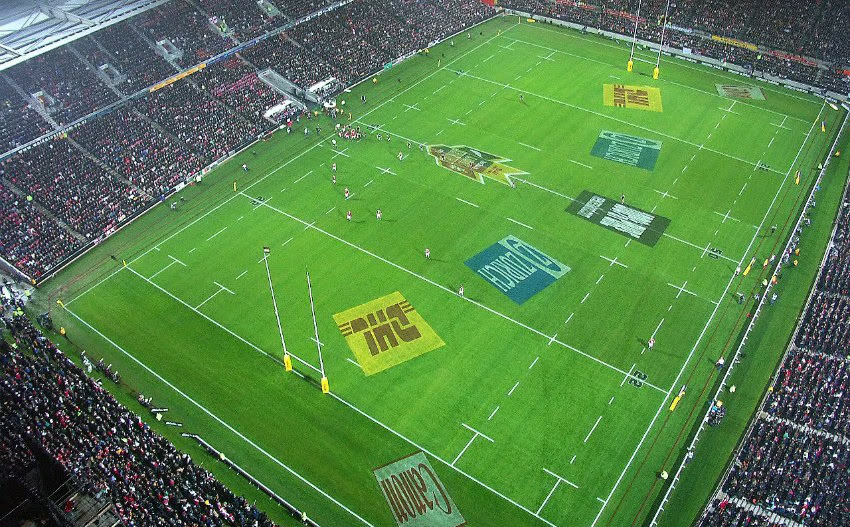

Now is the part where I kill Todd Howard.

You see, in order for these numbers to be meaningful, we need to work out how in-game space translates to real-world measurements. Unfortunately, Fallout 4 has an inaccurate map! There is no single measurement that was used for all locations!

I had wanted to use Fenwick park (Diamond City) as the scale of reference. It's an in-game equivalent to a real world place, should give us the scale, right? Nope, it's way smaller in game. Still, that's promising, right? It means that a small amount of in-game space has a much larger real-world equivalent.

The problem is: I can't find the numbers for either. A bit of very clumsy maths tells me the field is...

...(94.5m x 92m) divided by 2 = area of the triangle between first, third, and home... which is visually about half the field, so doubling it should get us the full area... god I'm an idiot that's a square with extra steps...!

...8694 metres squared, or 93,581 square ft. Is that right? The original Fenway park, like the area of the block and the stands and the building, that's apparently 365,000 square feet (or 33,900 square meters). I was thinking that it was too much, but now it's sounding possible.

Also. I know it's not exact, since the field is wobbly. But uhh... most accurate way of measuring with those irregular boundaries... is, uh. Calculus.

Which I can't do.

Believe me, if I could, I would. The need to know is a terrifying thing.

But the question still remains: how big is Diamond City in-game? I can't find a meaningful answer. I saw a reddit comment saying that it's visually about 1/3 the size of the real thing. That's interesting. In fact, the only way I can think of to do it is...

...walk that distance in-game, and count the steps.

Simple enough, right? Hahahahaha... if only. If that's my only recourse, that means I would need to do that... for every settlement. But I've looked and looked, and I can't find another way to measure that works. God, it's going to take so long. That's 23 settlements. Some have really weird boundaries! I can't do calculus - I'm just gonna have to walk in a straight line, and do my best to be as accurate as I can!

The lovely part of all this, of course, is we get to imagine what Diamond City might have looked like if it were a 1:1 same depiction of Fenway Park. There would probably be more alleys! More shops! It's interesting, because the game feels like it's pretending to be a big area, and is artistically trying to paint the picture of one, rather than actually simulating it. It's probably meant to feel like a regular old nest of people, all packed into a really close space! I kind of like imagining how that might look, instead: a walled city within a city, with houses stacked on top of each other, brushing elbows with all walks of life...

...oh god, I'm gonna have to work out how much they eat too, aren't I.

Maths time. For Diamond City, we're going to assume (perhaps optimistically) that the distance is accurate to the pre-war park. If you didn't know, Diamond City has the bases scattered around its city plan, and if you run through all of them in a certain time, you get an achievement. I walked the distances multiple times to make sure I got an accurate average. I also tried to take as direct a route as possible.

In Power Armor steps, it is:

The distance from home to third is just ever so slightly longer. Still 18 steps, but just... almost that little bit more. As we look at the real life measurements, we get:

Putting that together (real life divided by in-game measurements, to see equivalent of one step to real life distance), we get:

Given those come out to about the same, we can call that a pretty accurate measurement.

Thus, to find the area equivalent, we only need to times steps to see how it measures up.

That's some super-compressed dimensions. These measurements seem like a lot. The actual question is... will they be enough?

You know what this means now, don't you. We need to find the area in steps of all the settlements, from Hangman's to Spectacle. We're going to do this as accurately as we can, using the method for irregular shapes where you break it down into rectangles or triangles, and use the formulas seperately, and add it all together. It's not going to be perfect, but it's going to give us a basic idea of the space we're working with, since once again, I can't do calculus.

Welp, it won't get any more done by avoiding it. I might just do the Sector 1 settlements, right now, and fill in the rest as I get time.

Basic dimensions in 'steps' Area in 'steps' squared Area equivalent in real life metres squared Notes
Abernathy Farm (19 x 55) 1045 27,170 Big rectangle.
Outpost Zimonja (13 x 21) + half(22 x 6) + (8 x 7) 395 10,270 Main rectangle + back field triangle + little entrance rectangle.
Red Rocket Truck Stop (21 x 37) + (19 x 3) + half(20 x 5) 884 22,984 Main rectangle + Concord side hill + road area.
Sanctuary Hills (90 x 80) 7200 187,200 Kept getting stuck on trees and shit. Given the size of the 'island' it's fair to assume bigger rather than smaller, so I got a bit sloppy measuring it out. It's good enough to know what we're working with.
Starlight Drive-in (31 x 47) 1457 37,882 I love when the build area is basically a rectangle.
Sunshine Tidings Co-op (44 x 38) 1672 43,472 Once again getting lazy with it. It's not like they'd be limited by boundaries in real life - those exist in the game so cells are loaded properly.
Tenpines Bluff (28 x 16) 448 11,684 More than you'd think, but still small, right?

And just for fun because I find it interesting, let's check the actual population limits for available space. For reference, 20 ppls worth of food on minimum rations is 2927.6 square metres, average is 63,621.4, and maximum is 217,460.8 square metres. Check the table above for how much space is available at each.

20 Settlers Min Rations Avg Rations Max Rations Comfortable Average # People
Abernathy Farm Yes. No. No. 8
Outpost Zimonja Yes. No. No. 3
Red Rocket Truck Stop Yes. No. No. 7
Sanctuary Hills Yes. Yes. No. 58
Starlight Drive-in Yes. No. No. 11
Sunshine Tidings Co-op Yes. No. No. 13
Tenpines Bluff Yes. No. No. 3

Fuck me, someone check my maths on Sanctuary. Surely it's not actually that big, that can't be right.

But wait, have I... have I done it? Is the maths part done - at least for now? Fuck me, I think it is.


The thing I've been thinking this whole time, though: how do we do this without killing the world again?

My current idea is to integrate some crops into the wilderness, and letting them grow 'wild' so to speak. You don't need much room for hazelnut trees, or mutfruit. Why not plant those deep in the woods? It brings game into the area, and lets you forage as you go, on hunting trips.

The thing I actually need to work out is the entire ecosystem.

It's a funny thing that Ozzie's 'goal' is to eat apple pie again. Because I've heard this saying, recently... 'If you wish to make an apple pie from scratch, you must first invent the universe'. Looks like it's from Carl Sagan. Not really familiar with him - a scientist and a musician, though, it seems.

I'm also remembering the quote 'Despite all our accomplishments, we owe our existence to a six-inch layer of topsoil and the fact it rains." from Paul Harvey (1978) U.S. radio broadcaster. I believe I've heard it mentioned in regards to the Dustbowl, an area of America that was dessicated by over-farming in the 1930's.

I'm also thinking about Dungeon Meshi, which feels like it's trying to answer the same question I'm asking. How does it all work?

Because to make an apple pie, we need to think about how long it takes to grow the trees, how much space for the wheat to grow, how to mill the flour, where to bake in an oven, eggs, chickens for the eggs, what the chickens eat, the impact on the environment of the wheat, trees, and chickens (and what they eat), who's taking care of the wheat and the chickens and the trees and milling the flour and baking the pie, the means of doing this to prevent ecological collapse from consuming too many resources without giving anything back to the ecosystem at large, weather and environmental factors, war, disease, famine... an apple pie contains the world.

Another little tangent. The 2020 bushfires in Australia were widespread and horrific. The thing I remember about them though, is that the wine made in those years tasted smoky. The word in wine-making for the holistic combination of factors that create a specific wine in a specific area is 'terrior'. The terrior of those years affected the grapes, and thus the wine.

(I will be real though: I learnt the word from Jeff Vandermeer's book 'Authority'.)

Ultimately, the thing we really want to create in our in-world fan-culture is homeostasis - but for the environment. We want a culture that 'auto-stabilises' in accordance with fluctuating external conditions. So it both needs to pay attention to those conditions - all the shifting factors, some invisible to human perception, the whole 'terrior' - and adapt with a minimum of effort. Because people are lazy.

I don't honestly know if that's even possible to do. A culture designed to... change without changing?

Hold on, is that why Native American and Aboriginal Australian cultures were nomadic? Like, duh, it's because there's different food in different places at different times of year. But as far as 'changing without changing' gets, always being on the move - and thus needing to adapt to the new places seamlessly, while maintaining an internal cultural equilibrium - that's close, right?

Maybe I can't even focus on cultural values. I can't say 'people will do this' or 'if people just...' about anything, because people will never 'just'. Fuck man, I can't even exercise now, let alone get out of bed unprompted at 5.00 to feed chickens that aren't mine. How can I expect anyone else to choose to? I need to make a world, and an environment, where people can live in... no, are forced to live in harmony with the environment and world around them. People don't change unless something... disturbs their equilibrium. It's laziness, but it's energy efficiency. You stick to a routine because thinking about what you're doing costs energy, and the brain cuts corners to save as much of that shit as it can. Energy is expensive.

Thus, change cannot be optional.

Like it's all well and good to suggest people take shifts in the fields, but experience matters for a lot of these jobs, and someone inexperienced taking it over to 'give someone else a break' may make more work down the line. So if we want everyone to have that experience, there needs to be something forcing them to. I'm not saying it's autocratic. Autocracies are unstable as hell! But there needs to be something, some basic drive, that forces people to adapt without losing the ability to adapt.

Love? No, that's not universal. All I can think of is hunger.

Hunting needs to happen. Let's start there -it just can't exist otherwise.

Let's take the fact that they live in a constant warzone... and use it to our advantage, since we're basically making up a culture, here. So the laziest way to hunt is to set traps, right? If that becomes a constant practice - teaching kids to set traps, as well as spot and avoid them - that handles both hunting and settlement defence.

In addition, we have dedicated 'sharpshooters' who when not needed for war are just hunters, who go out into the woods every day to check the traps, try to bag game, and come home.

The thing is though: people tend to assume hunting is easy, right? Oh, just throw a line into the water, fish will just leap onto your hook. Go bag a deer for dinner, like picking up milk from the store. No! Animals won't come nearby if there's nothing to eat. This is why giving back to the environment becomes so important - you need to make a place that wild animals can live in, so that you can eat the animals. Stewardship. There's a lot of Radstag in the hills up behind Sanctuary and Abernathy, but how much is there really? In addition, they're skittish as hell. You'd have to go on a long-range hunting trip to get anything worth returning with, and how are you going to store and carry that for the journey back? To say nothing of competing predators, like Yao Guai, mongrels, Death Claws, and Radscorpions...

Nevertheless, the existence of such predators implies they do have enough to eat, somehow. Maybe that's humans, sometimes... but still. It's encouraging.

So. Deer. It's the clear Radstag equivalent, and we have the numbers... 437kj per 100g, most of that being protein. Let's say the deer all suck, and ultimately the only edible stuff is about 50kg worth of meat. That immediately becomes so much food. Holy shit.

Let's take a step back and look at this from an environmental perspective. The more hunting and farming we're doing, the greater the impact on surroundings. So first we need to know how this culture benefits the environment.

The old adage goes: you learn what you test for. We are inherently limited by human perspective. And I can say what we need to do, but it's not the sort of thing you can understand unless you work it out for yourself.

Like. Imagine being a tree. Your thoughts are more like feelings. Your interaction with the world is static: to touch something, you must grow around it - you can never let go again. Insects nibble at your body. Rain comes at its own schedule, you cannot go towards it, only wait for it to come to you.

How different a perspective must that be? And an ecosystem is full of different perspectives! The birds are concerned with fruiting trees, and seeds. Deer graze constantly, always aware of danger, always needing to drink. If we consider the wild world an Eden made for our benefit - a bigger backyard garden - we will miss far too much! And we will be unable to live within it, if we cannot empathise with those we exist alongside.

But I run the risk of turning you away with this 'hippie' talk.

We want to create something of an 'in-between', I think. Not absolute wilderness, but not industrial farming practices, either. Industrial farming definitely isn't the solution: those vast fields of wheat and corn you see in movies, those are horrific monocultures, and they're incredibly bad for the ecosystem. The ideal is something wild, but managed - at least in places - in order to allow all life to flourish, because the greater diversity, the healthier everything will be.

A very very basic place to start is by asking 'what eats this'? And 'what does it eat'? About the canon creatures in Fallout. And also... how much does it eat? Because all that shows how much is actually needed to support that wildlife.

A very basic rule is that there must always be more of whatever's getting eaten than what's doing the eating, all the way down to insects.

I'm sure you can see the problem with this picture, right? There's too many introduced species, and artificially created species. It's imbalanced. It's also, and let's be real about this: an ecosystem designed around humans, because it's for a video game. Bigger enemies are interesting, I don't know what to tell you.

There are some changes we are capable of making, however. Starting from the top, working our way down.

1.

2.

3.

4.

5.

6.

7.

8.

The bargain humans are making with existence is this: that if a higher population of them exists, they must not take more from nature than they give back. That's the basic premise of sustainability. And it is possible, because we're smart little fuckers.

In other words, this is beginning to look like a culture that values intelligence, empathy, hard work, the environment, and community - because those are all the things that lead to success.

I would like for there to be demolition practices: going out with heavy machinery with the intention of dismantling pre-war buildings and waste, and using the materials to improve the environment and the community in some way.

Hm. If this goes well, it will create an incredibly lush area of land, with more than six inches of topsoil. What exists to prevent people from undoing that work with higher density farming practices, later down the line?

Urgh. Currently, nothing.

Hm. Possibly... human laziness? That or, once again, nomadic practices. But you can't make people move unless they need to. Bugger!

It might be all right to have more than one answer to the problem. One: only passing on sustainable knowledge, and letting higher density practices remain in the past. There's still a chance of people re-inventing it, but since that takes a lot of effort and humans are lazy, it protects us somewhat. Two: creating a partially nomadic culture. Different things available at different areas? Wider courier system, and patrols? Hunting and scouting parties? Troublesome, since the war-like nature of the wasteland requires siege-ready settlements. Three: expanding laterally downward or upward, Vaults or towers, and researching plants that can be grown in such conditions? It would take less pressure off the environment to be able to do so in a sustainable way. It also raises the slight possibility of settlement-to-settlement underground highways. The risks maybe outweigh the rewards on that one, though - maybe regular highways are where it's at. If travel is easier, people are likelier to move. In addition, by planting crops wild along the sides of said highways, it reduces the burden on pack Brahmin if you can forage as you travel.

Thus, okay... we can do the maths on that. That almost sounds possible, and sustainable!

Other ideas: possibly a gate tax, to enter compounds? Either in foraged food, or caps. Trying to figure out some way of getting people to forage communally, rather than just for themselves. The idea of a kitchen hall is a good one, but I'm not sure how it fits in.

Possibly the idea of an allotment of land given to households? I'd rather lean towards communal living, somehow: apartments or multi-family blocks, to save space. The idea of giving people a plot to take care of is rooted in settler culture, I know.

We want people to help each other - and we want that to be the optimal solution. Culturally, selfishness must get you nowhere.

Okay, talking with my partner has brought up these solutions:

Another idea here. We want people to be educated, yeah? Thus it must be in the reigning body's best interest for people to be educated. That somewhat points to a partial democracy, as a system. It's also possible, since raising kids is hard, that perhaps there's some kind of coming of age 'tour' where school groups go round and get a schooling at different areas? And maybe it's the sort of thing where you can stay as little or as long as you like, but you have to go through everything...

Like, the idea of tying rewards to work and learning is important also. It could be that to combat dissatisfaction, the idea of always being able to 'move away' from the current place you're at encourages the people in charge of it to make it a good one. Maybe groups can band together to submit 'new compound' requests, essentially asking for an allotment of resources to go somewhere else and build a new compound there - with some caveats: that they must be able to prove they can do so sustainably, that it's a pre-war ruin or otherwise polluted area that needs to be re-wilded, that everyone part of the project is agreeing to work together... so maybe nobody is in charge at all, for the first few years or so. It would essentially be 'asking for extra work' but probably worth it to people for freedom's sake, you know?

Huh. I'm now thinking, if it doesn't work out, what happens there? Probably a black mark on everyone involved, probably they'd need to re-do the schooling tour if they say it was for lack of know-how. Also by limiting the program to polluted sites, it forces them to use re-wilding techniques before they can farm, thus preventing the use of destructive practices. That's essentially destroying the land you spent so long supporting for no reason.

To combat crime, compounds should probably have population limits. Law of large numbers requires harsher policing measures, and we want to avoid that. It should be more focused on reintegration, building skills. The idea is to keep numbers small, so if a crime is committed, it's harder to hide from it, and punishment can be more gentle if it's something silly and unimportant.

The population limit should be set by how much food they have, obviously. Hm, but if populations are constantly fluctuating with 'tour' groups, that makes it harder to manage for the people in charge. It's seeming like these tour groups need to be far smaller, to avoid the 'law of large numbers' rule of misbehaviour. They should also be randomly assigned, rather than letting people pick for themselves - forcing people from an early age to work together with people different from them helps prevent bullying and tribalism.

Maybe there's an idea also to 'sponsor' programs that people can get together to do: for example, if people wanted to plant crops along a road, they could apply for a program, essentially asking the government to pay them to do it / provide the resources to do it. It would depend on what resources that compound had available, but it would encourage people to seek out ways to improve the world around them. Like maybe research projects the same, or community gardens, or making some instruments or songs, or whatever. This would allow for luxuries to exist, or for people to look into ways of making their lives better.

Hm, that has the potential for abuse, though. If you expect people only to put in effort when it personally benefits them, a lot of those projects are going to end up selfish, you know? Like most people just want to go to work and have an easy day, and come home to something nice. Extra effort comes from avoiding work, or from selfishness.

It's pretty clear to me that the harshest punishment possible is exile, and that there does need to be a physical injury or scar given to mark this sentence - perhaps even something that says what the sentence was. By having people know they will be cast out to fend alone if they mess up, that may encourage them to rewild the outer places even more, as they can expect to one day rely on it for food. By also having the sentence clear on them, it makes them think twice about comitting certain crimes, as that will be something they can't hide.

In fact, maybe exile is kind of a common thing. If you mess up somewhere, they won't let you back in - but you can go somewhere else, if they'll give you another chance, depending on what you did wrong. Being unable to hide your sins would make you more likely to feel shame for them, and avoid them in future. A common place to brand/tattoo would probably be the dominant hand, since you could scar it further or cut it off, but not without risk of being unable to shoot, thus making you less of a risk.

It's also the sort of thing you could maybe apply for, except in a positive way? Like government-official tattoos or brands you could choose to get that marked you as skilled in some area, thus making you valuable if you ever decided to leave and apply to live somewhere else. It would be painful, so the idea of these being small is good. Hm, maybe ear peircings - no, that's kind of a fight-risk. I dunno, just spit balling.

The idea is good for people to be able to apply to live places for like, certain roles? It would encourage freedom, building skills, movement, and effectively allocated resources. So like, if Starlight needs a radio operator, it could put out an open position to people via the paper, who could then send out a request to apply to live there. There's some flaws with it, but it ultimately works. I think the ultimate thing it needs is for people's experience to be tracked automatically, somehow - like an archive available to all compounds, electronically or by radio. That would make it way more difficult to lie about the exact kind of experience you had, and far more of a crime to tamper with those records.

Hm, perhaps a bunch of copies of the archive. A paper one, an electronic one, and when you die, a stone one - that would eventually lead to people feeling more connected to the place and the culture, if they could walk past all the memorials of those who came before them. It would also give people something to look up to, and aspire to, if they could see achievements laid out in real time.

Ultimately a society is a measure of 'what do these people reward' and 'what do they punish', right? Humans favor connections in any place, the differences in each come from those questions.

When caps are a measure of success, merchants become the dominant social class, leading to inequality tilted in their favor - and away from people who actually make the food.

After some more conversation with my partner, we figured out on some stuff.

First, a democratic election process - each person, one vote. To change without changing, this is needed. Before voting, though, there is a mandatory test - if you can vote, you must take the test. It only has some very basic questions about the responsibilities of the people you are voting in, general litmus test questions about working in a community / caring for other people, and how the society works at a fundamental level. It is super super basic. The thing is, though, if you're an adult, and you fail it: you can't vote, and you must do a 'society' course, which is like a year long work experience thing at each of the various areas.

The idea is that if you're not community minded, or if you don't have a good general idea of the world around you, your opinion probably isn't worth much to the community. But because this might not be your fault, you can go get an education in life, after which you can take the test again for your vote to be considered.

Furthermore, the test is available to everyone, maybe as low as five. And you get it every year, and it only changes if society changes. And if you pass it - maybe at thirteen, maybe older - you can vote too.

The other thing is instead of a tour, it's a three year program from seventeen to twenty where you shadow each of the various areas. Military training, basic physique and strategic thinking, how to eat healthy and be good to your body, hunting and setting traps. Community work, like construction and food production, cleaning, all the little things that go into homecare. And education, perhaps basic medical or nursing training, first aid, mathematics, and more complex research projects.

Basic schooling would happen at a younger age: learning to read, sign, identify plants, butcher animals, very basic fitness.

The whole society should essentially be a survival school! Because it's preparing for the fact that, if the worst happens and a compound is destroyed, the scattered survivors should have enough basic skills between them to start over. We're trying to avoid the situation where 'the one person who did all the farmwork' is killed, and society stalls.

The other purpose of the tour though is that these big areas of society will always regularly have an inexperienced but high-energy workforce on standby to help out, which is sometimes all you need. So it solves the problem of experience, and also the problem of one person being responsible for too much: there's going to be regularly people there to help if you need it.

The other necessary thing is population limits at the compounds. It might seem cruel, but it's essentially making sure they always have enough to feed the people there. So if you go to a place, and they're like sorry, we're full, you can say Hey, would that change if I were to help hunt or forage? And sometimes the answer is yes, and you can stay. And sometimes it's no, because food production is limited by what the environment can support as well as what people can make, but that's okay because you can always try at the next one.

It's also like, if there's anyone wanting to make a compound, they can go and do that: the caveats of sustainability and skills have been mentioned, I think, but also the government will support you to do that.

How To Make a Waystation

Waystations are small, easily defensible positions with a frequently topped-up store of supplies. They exist at the end of highways (a jumping off point before un-managed wilderness), between very distant compounds, and in very dangerous areas.

They allow people to travel light, and thus move faster - either in times of war, where armies need to move from position to position, or in peace, where patrols and caravans are coming through on a regular basis. All compounds begin as waystations, and then if the surrounding area can support it, they are expanded.

Waystations are litle more than a defensible position and a hidden (and locked) stockpile. They do have regular visitors, though: hunters moving through the area, soldier patrols keeping the roads clear, research teams checking on the surrounding wildlife, scouts checking on the supplies, foraging teams, caravans of supplies, and couriers. They are likely to be frequently targeted by scavengers, thieves, exiles, and people from outside the co-op/union - it may be common, then, for the surrounding area to be heavily trapped, and for them to double as hunters cabins, military outposts, or camping dorms for travelers.

The idea is that anyone moving through casually shouldn't be able to access the stockpile unless it's an emergency, and should be travelling with their own supplies, or by foraging through the surrounding area. And if there's nothing around - they should probably move on!

Step One.

Identify the best place to establish a waystation. This should be somewhere easy to defend, and well-hidden. It also should be as close to a pathway as possible - the order of operations is 'desire path', then waystation, then road, then compound.

Establish a very light campsite there. Don't commit to construction until the site has proven safe over a long period of time. Keep the site very small - off the ground, if there are trees nearby.

If the site is somewhere dangerous or polluted, now begins the process of removing that danger and pollution, using the waystation as a military outpost.

Step Two.

If there are no problems with the location, and the site is seeing regular use, now begins the construction of defences, and a stockpile area.

This is ideally an underground bunker, but any solid structure works: e.g. a shipping container. Supplies should be kept chilled, if possible, and suspended off the ground to protect from pests. It should also be hidden if possible, and disguised as either part of the surroundings, or as a different structure.

Defences should be focused on creating cover, choke points, and traps at said choke points, with possible lookout towers in areas where disguise is not possible.

Construction can be made easier with machinery, but it will not always be possible to transport machinery to the location. Thus, they can look like anything from a bunch of crates buried under some bushes, marked by a lookout tower nearby - all the way to an underground bunker underneath a small cabin, with turrets and half walls at the perimeter.

Step Three.

Once the waystation is established, it is written onto maps, and regular patrols are sent through to check up on supplies. The area around is also planted with flowers, medicinal herbs, edible trees, and other helpful plants, thus increasing biodiversity while making it easier to establish a compound there later down the line. A system of compost and waste is created to increase the fertility of the soil, as well, by promoting bacterial growth and the mycelium network.

The goal is an ecosystem: therefore waystations must take less than they give back. They do not belong to anyone alone. If people are using them to farm, they should be asked to move on to a compound, where they can be taught proper sustainable practices and work towards the common good of the community, rather than just for themselves, and the incident reported.

Given the waystations are created and managed by the union, it should be rare that people refuse. In the event they do, after fair warning, they are evicted, marked, and escorted to the edge of the managed area, with the warning that if they return to try the same again, the same thing will happen, but if they return to farm for the community, they will be accepted.

This way it is easy for patrols to determine if a person has been evicted before, and thus how much grace they should be shown. It sounds harsh, but it the more foolish thing is to let people take advantage of you over and over.

How To Make a Road

The next step is roads. Well-cleared, regularly patrolled highways make travel safer for everyone. They also end up an obvious target for highwaymen and bandits, hence the need for regular patrols.

Before a road can exist though, the clearest path through must be determined. Sometimes this is the existing desire path forged by constant travel - but sometimes the optimal path is blocked by danger or an obstacle.

How To Make a Compound


Literally the only way it works is if we expand beyond settlement limits.

Lateral expansion: up and down. Hunting parties into the glowing sea. Experimentation - science bullshit go. Raiders more akin to bandits, aka remnants of a war, a soldier force shattered. Minutemen 'bad' groups. Fake 'radovore' animals and plants. Skyscraper-esque complexes, maybe more or less open to the elements?

Problems: resources are finite. Space is finite. Water is finite. People are less finite, but that depends on the limits people set as well as available resources, or present dangers. How to set cultural population control limits?


After having thought about it for a couple of days, I've come to two conclusions. One: there is no conclusive answer, and we should aim instead for a 'direction'. There is no strategy without flaws.

For example, if our concerns were different, we could have Ozzie in charge forever - or Codsworth, or some other immortal equivalent - who would keep society on track in line with environmentalism, sustainability, community, and our other values. However, this would be a dictatorship. It's benevolent, sure, but still a dictatorship. And in order to continue sustainably, he would need some way of enforcing that dictatorship - a tyrant is nothing without people to carry out the methods of control.

This is an interesting thing to explore, given the themes of Fallout. Like, ghouls live for so long that even if Ozzie promises, now, never to make selfish or controlling choices, he lives for so long that it's an impossible promise to make. We already know he doesn't care for people as a whole - only when he gets to know them. Besides this, it's a human fact that power corrupts. Being immortal doesn't make you immune.

Thus, a rival strategy would be to dictate, right now, that nobody is in charge. Do everything by democracy, inspire people to work together for everything. And despite what cynicism may tell you, this would work! People on the whole are social animals.

The problem with that is it leaves the system open to outside corruption, ambitious individuals - and crucially, as far as we're concerned, it means that people are more concerned with each other than the environment. There is nothing to prevent people from over-farming the soil in order to feed a higher number of people, if the main thing society values is helping other people.

Here's the situation: forty, maybe fifty years down the line, this society is thriving. People hear about it, and they come and want to join. But the settlements are already at capacity - you know the maths! Even if everyone eats onion soup and nothing else, there is still an upper limit to the amount of people that can exist in a single place.

And it's not so simple to spread out, either - New Vegas, for example, is in the middle of the desert. The same environmental approach won't work in a place that hasn't had regular rain since the bombs fell. The Commonwealth is on the coast - that's the only reason it's possible. So where is there for people to go?

If there are people at the gates of Sanctuary, living in campsites outside the walls, foraging the surrounding area barren, and farming the soil to dust, what should be done then? Kill them all? Move them on - by force? Accept only the children, splitting families apart? Create vast, underground facilities with room to grow all the crops needed - something that won't be possible in the time available? Put them on ice, and wake them up one by one when resources are better, with no guarantee this will ever be the case? Neither the dictatorship nor the democracy has a satisfying answer, because it's a question which has no good answers.

Strangely, I'm reminded of Pathologic - and the decisions it forces you to make. Granted, I didn't play all the way through, but I played far enough to feel the noose of time around my neck. I literally didn't have enough time to save everyone - heck, barely enough time to stop myself from starving to death over and over. Like, Ruben! The worms smacked me to death so many times - I literally couldn't get past! I couldn't save him!

I ultimately believe a few things: first, that people will never do something for the sake of doing it. In other words, if your grand plan relies on people 'just' working together, or 'just' caring about each other, or 'just' taking on dirty jobs if they can see nobody doing them - that plan will fail. Maybe only a little bit over time, like a statue built out of sandstone - but it will crumble. This is because people are animals. Our brains aren't 'designed' to do anything - they are an evolutionary accident that happened to be successful in keeping the human creature alive. If it isn't related to routine or self-interest, you cant rely on people to do it.

I also dont think systems should be built with their worst members in mind: the person who takes a sledghammer to the wall keeping everyone else alive because it's 'funny' is a problem you can't prepare for. That said, I really don't believe that everyone in a society cares inherently for other people. People help each other because it benefits them - that's the advantage of a social species. Modern day human society has more in common with insect hives than primate social structure. If we measure intelligence by co-operation, ants are smarter than us. If we measure it by memory, elephants are better. If we measure by inter-species compassion, whales and some primates have one over on us. By any other metric except the ones we set for ourselves, as a species, we're not smart at all. Our advantage comes from constant procreation and creative problem solving - that's what let us take over the world.

Despite this, I think people are ultimately good, given the chance. Maybe the best we can aim for is a society that gives people the chance?

I had the idea of basing society around education: that positions of authority are given the title of 'teacher' or similar. There was also the idea that positions of authority came with the caveat of worse rations, to de-incentivise people from aiming higher out of greed, at least. Is there a way to make a unified government that doesn't invite corruption?

I think what we have is small enough that this could work: if people are able to leave whenever, the people who do all the work can always go and make their own place somewhere else. That makes it hard for anyone to get pushed around, or stuck doing all the work all the time.

It does leave us with the problem of 'what kind of unified government do we have'? And the best I reckon we can do at this juncture is a council, I guess, of everyone who's ever passed the 'vote' test...

Wait, what if we organise it like a union?

I don't know if that works though, because unions exist in relation to businesses - could the government be considered a 'business' in the sense that unions exist to bargain with it for better conditions? Does the system still work if the government is 'technically' the business? Also the way unions work is tied kinda directly to capitalism: they're invested in making their members heard, because members are the ones paying for the service, and if they don't do a good enough job those members will leave - or others won't join.

Hm. Having it predicated on being 'able to leave' is familiar though. God I feel so stupid. Like, what the fuck is an economy, anyway? Money is our madness, our vast collective madness! For mankind says with one voice : How much is he worth? Has he no money? Then let him eat dirt, and go cold. And if I have no money, they will given me a little bread, so I do not die, but they will make me eat dirt for it!

Could it work if 'leaving' the system is dependent on people 'leaving' the settlements? Like it's hard to get people to stick around... ah, fuck, I don't know. Like it's a union against the rest of the Commonwealth, so to speak? Or - and this is my private desire - a courier service? No, that's no way to run a system of government.

But like, having members who come from the rest of the Commonwealth is fine for right now, sure. 'Dues' are in the sense, the idea that you relinquish... hm, perhaps the excess of whatever you harvest? Or maybe it's simply that you aren't reimbursed at all, you feed yourself... god. I'm so stupid. This is so hard. But also it only works for right now, because if there's ever a situation where this becomes successful, it raises the problem of a ballooning population some years down the line, and then how does that system resolve? I guess they can still leave, but they're heaps less likely to.

It's important to start from a good spot though, cos it's so much harder to change stuff down the line. There's the idea of hearing grievances only if people put together a council about it? It would head off selfish requests if it forced people to organise to fix the problem, first. That's not half bad.

How do we live? What do we need to live?

And even if we could make the perfect system, would it be interesting to read about? Hm. I guess probably not.

We could make the sandstone sculpture, then. Perhaps some system that does the things we want it to, but is dystopian in other ways. Perhaps something that makes the sacrifices we can deal with, and is not unbearable in the ways that matter?

Okay.

Piper's paper is a good deterrent in the same way branding people is: it's not prevention, but it hopefully means hesitation before doing something terrible. It also is good avenue for storytelling if Ozzie is continuously going round to all the settlements (lacking an organised spy network) to see how things are doing there. The difference is that if there's something wrong, he needs to go back to Grognak and the others to figure out what to do about it, rather than having the absolute power to stop it then and there.

Weirdly, it's a good thing we made him weak at basically everything. Weakness is maybe the precursor to co-operation. Here's a thing you can't do: go find someone to help.

Another strategy he could use, in that instance, is to find the workers of that place, and basically say 'hey come live with us, you get an education free, and meals no matter what'. The trap, of course, is that's because you're not necessarily going to own the land you farm on anymore, but since you never did anyway, it makes people more willing to work with the system rather than against it.

Thus, destabilising imbalanced systems wherever you find them, while making your population stronger.

Also we're somewhat trapped by what we've established already exists:

Okay here's an idea. What if people can challenge for positions, using the skills of that position? I'm not sure who sets the nature of the challenge... maybe both need to agree to it. There also needs to be an impartial judge, or a council of those the decision will affect standing by to dismiss the challenge it it's unfair.

Say you don't like how the housekeeper of the barracks does things. Say you think you could do it better. You could issue them a challenge - and beat them in 'housekeeping' specifically. Maybe in this instance you would take over running the place for a week, since it's a role based around general organisation. And anything you changed would go back to normal at the end.


< Previous:'Harvest Season'
< First        Archive        Last >

Author's Notes

Chapter Gallery