
fallout 2d20 ttrpg - WORK IN PROGRESS
"In 2077, the storm of nuclear war reduced most of the planet to cinders. From the ashes of nuclear devastation, new civilizations struggle to arise, each with visions of a new future. They just disagree on what that future will be.
The choice is yours... but so are the consequences."
so, Fallout on the tabletop...
I've only played just the one session thus far, so this will be a place for ongoing notes! We're working our way through the Quickstart adventure. This will be a reference for me, and maybe for you if you're thinking of trying it out.
If you do want to try it out, I recommend skimming the Quickstart guide first. It's free, available here.
This page will have:
- Session Notes - what happened each session, how long it took, and any rule confusion.
- Character Notes - little overview of who's playing.
- Rules references - working towards a little cheatsheet, making notes for myself to help understand the mechanics.
Machine Frequency: Session 1 (Spoilers ahoy, skip if you want to play this!)
- The three survivors (Marvin, Tommy, & Augusta - pregen characters) are travelling along the road when they come across a Drumlin Diner. While scavenging it, they are attacked by hostile Eyebots.
- The Eyebots are recieving orders from a specific radio frequency, and are headed towards a plume of smoke in the distance - which the survivors later learn was a crashed Brotherhood Vertibird.
- On their way to loot the site, they encountered a Brotherhood scribe in Power Armor - an old man who asks them to check the crash site for survivors.
- They keep moving. They find a baseball grenade trap, and a small shack by a cliff. Inside the shack, they find a note saying 'Big Score Turned Me Off', from a scavenger who went to 'Bolton' looking to hire mercs. They are also attacked by some Radroaches.
Session notes...?
We're unfamiliar with the system, so getting this far took us about three hours. Roleplay's been great, been having a blast. System's still clunky, but that's why I'm here to write this up.
Q: What parts of the system do I have a basic grasp on, thus far?
A: Tests (d20 pool, DN, # of successes), AP, Attacks, Combat Ranges & movement, Actions + Minor Actions, First Aid, Complications, and a little bit of Effects.
Q: What am I still fuzzy on? What do I want to understand better?
A: All of the above, lol. But also Combat Dice / Damage, Luck, Chems, Injuries, Critical Hits, and NPC's are still a black box to me - also character creation, since we're using the pregens. Like, how do Tag Skills work, you know? Also is downtime really a thing?
Q: What were we confused by, at first?
A: Spending Luck or AP, lower number = better, how to physically roll a test (and set the DN), the difference between DN and TN (REMEMBER TO ASK THE GM HOW MANY SUCCESSES NEEDED BEFORE ROLLING), when to buy new d20s for a test, how to apply damage. Plus probably more that other people struggled with.
Machine Frequency: Session 2
- The three survivors (Marvin, Tommy, & Augusta - pregen characters) find the crashed Brotherhood Vertibird being attacked by Protectrons, with a sole surviving Knight.
- The Knight is in armor, for some reason. Tommy quickly frees him of his fusion core.
- Unable to move, the Knight tragically falls in the combat. RIP.
MARVIN
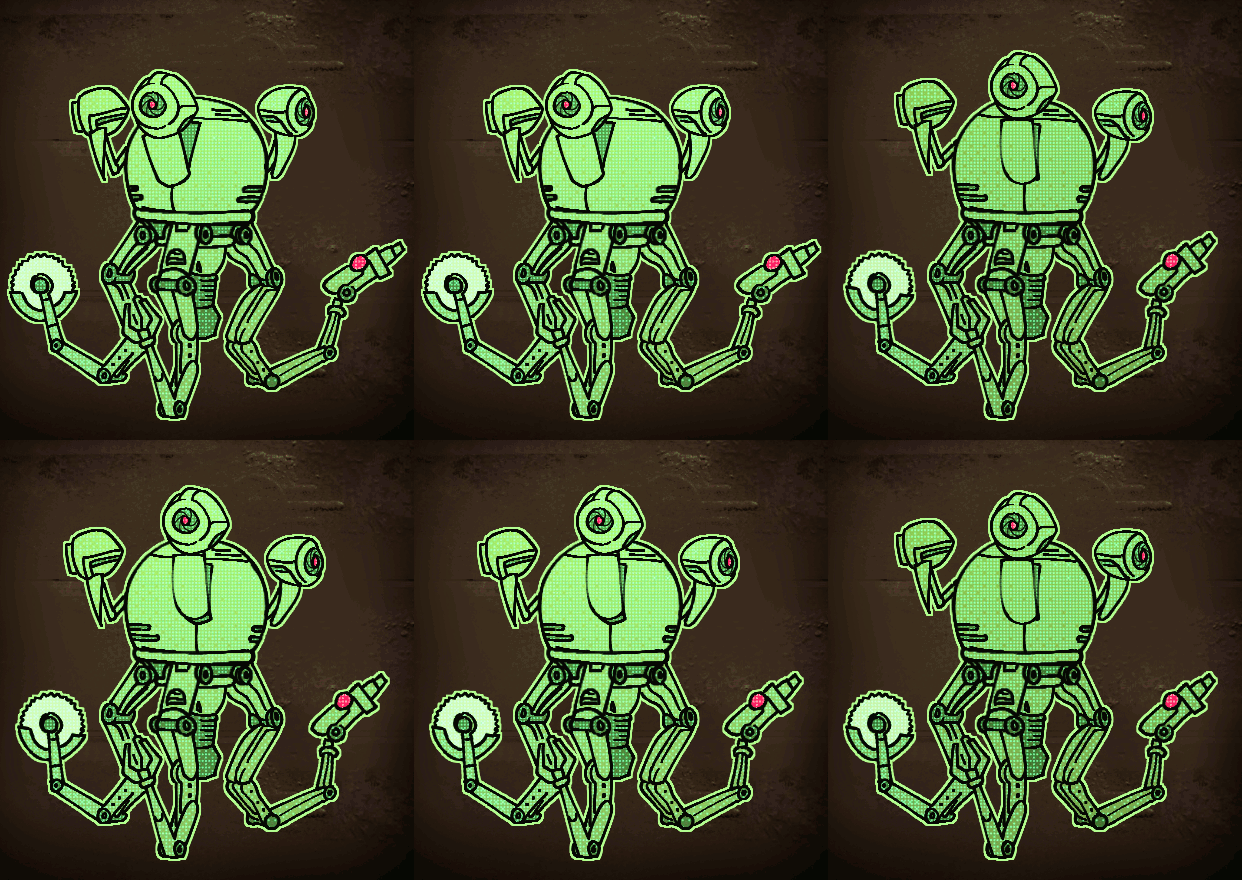
ORIGIN: MR. HANDY
PLAYER: TsKroony
As a late model Mister Handy unit, it began its life as a household servant to a smarmy Hollywood movie star. While it took many years for the unit to make sense of its feelings, it developed a strong bias against human selfishness early on. Unfortunately for humanity, its resentment has only grown over the years. Marvin presents itself as a caring, attentive, empathic friend to humans - in actuality, Marvin is extremely manipulative, sees most humans as pawns, and takes actions to subtly sabotage anyone who it feels is being abusive to robots.
'HAPPY' TOMMY DOYLE
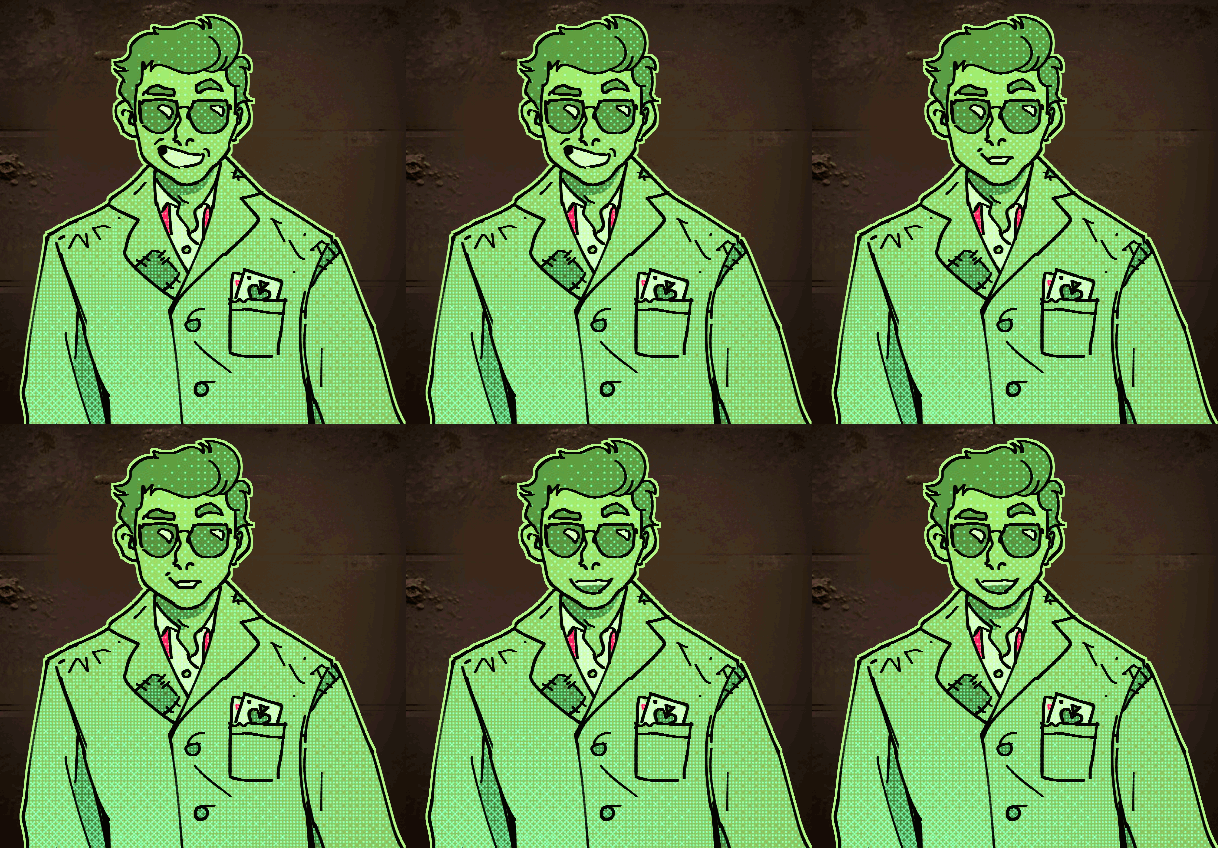
ORIGIN: SURVIVOR
PLAYER: Owl
Tommy Doyle was given the nickname “Happy” by his friends in Diamond City, due to his constant smile and slick charm. Tommy has lived in Diamond City his entire life, rarely venturing beyond the walls of the repurposed baseball stadium. He is a hopeless romantic with a tendency to find love in all the wrong places, often resulting in him being taken advantage of by more savvy survivors. He was recently taken for a large sum in a highstakes game with several shady individuals from the town of Goodneighbor.
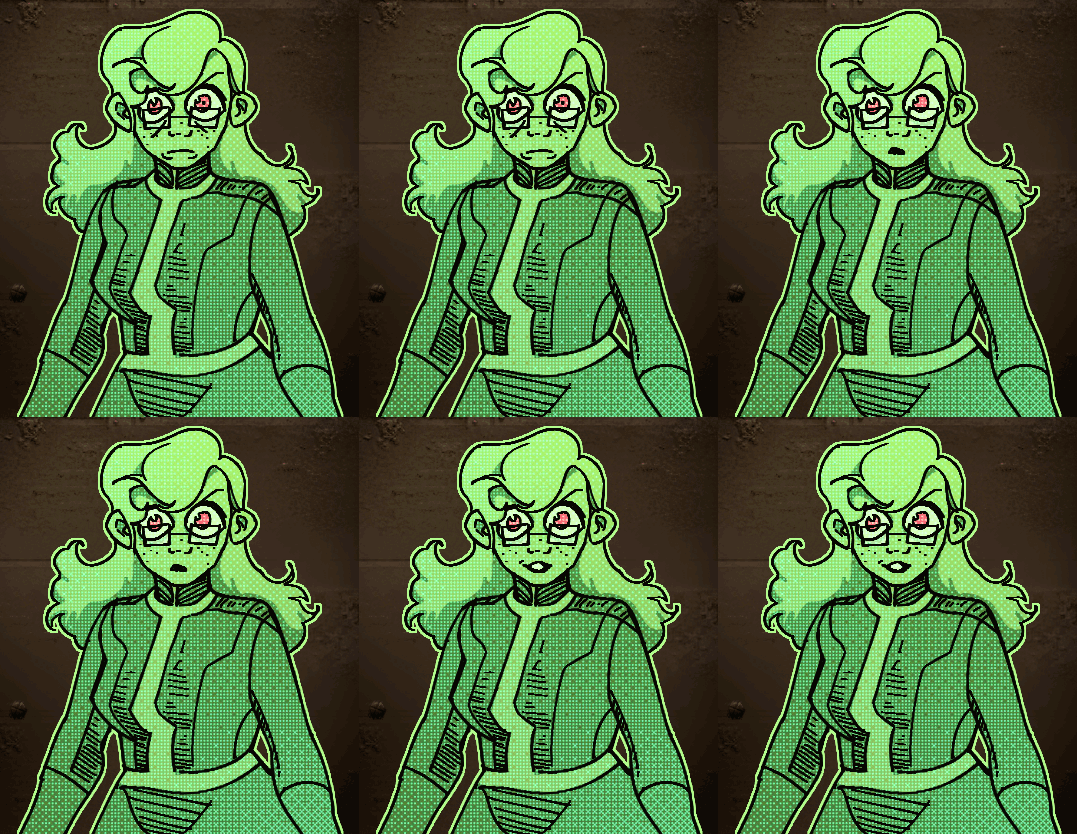
AUGUSTA BYRON
ORIGIN: VAULT DWELLER
PLAYER: swbones :)
Augusta Byron was aised in Vault 75. There, every child was forced to undergo intense schooling and brutal mental and physical tests by the vault scientists. Mere days before her graduation, #1179F learned Vault 75’s dark secret: every year, graduated students were systematically murdered. Horrified, she and a guilt-ridden Vault-Tec scientist organized a bloody coup. On the outside, she watched many of her fellow vault survivors die to the cruel realities of the Commonwealth. With an unbreakable will to survive, she breaks into pre-war ruins, looking for anything that aids her research.
bon's rules reference - cheatsheet
This is organised by 'questions I have', followed by their answers. It's organised in a kind of 'as I'm playing' way.
If you want a more organised run-through of the rules, obviously you should read the Quickstart instead. This is the learner's guide.
Basically, I imagine that my character wants to do something, I ask myself how - and then I look it up in the Quickstart, which is available for free. e.g. Hitting things is pretty common in Fallout games. Thus, what are the physical steps I go through to do that? What kind of dice do I roll - how many? What do I say? You get the picture.
Where you see a word underlined in green, Like So, clicking on it will take you further down the page. This is so I can link definitions together without cluttering the page. To get back to your exact spot without scrolling, just press the back button on your browser.
Where a word is underlined, it means it's important or memorable.
~~~~~
- Q: How do I make an attack? (pg. 21)
- CHOOSE WEAPON AND TARGET: Select one weapon you are currently wielding. Then, select a single character, creature, or object as the target. If you’re using a melee weapon, the target must be visible to you and within your reach. If you’re using a ranged weapon, the target must be visible to you.
OPTIONAL: Choose Hit Location: You may choose to target a specific part of a target creature or character. This increases the Difficulty of the attack by 1.
e.g. "I want to stab the closest Eyebot with my switchblade." - ATTEMPT A TEST: The test is determined by the type of weapon used.
- Melee Weapon: Roll a STR + Melee Weapons Test, with a Difficulty equal to your target’s Defense.
- Ranged Weapon: Roll an AGI + Small Guns, END + Big Guns, or PER + Energy Weapons test (based on the ranged weapon you’re using), with a Difficulty equal to your target’s Defense. This is modified by the Range to the target.
- Thrown Weapon: Roll a PER + Explosives or AGI + Throwing Test, with a Difficulty equal to the target’s Defense, modified by Range.
- Unarmed: Roll a STR + Unarmed Test, with a Difficulty equal to your target’s Defense.
- DETERMINE HIT LOCATION: If you passed your Test, roll 1d20 or a hit location die to determine the part of the target you hit. If you chose a specific hit location already, you hit the chosen location instead. e.g. "I got a 3 and a 14 - that's one success. And I roll the hit location die to see where I hit it... the left arm? Or whatever the equivalent on an Eyebot is, I guess."
- INFLICT DAMAGE: Roll a number of Combat Dice listed by the weapon’s damage rating, plus any bonuses from derived statistics, or from AP or ammo spent. Reduce the target’s health points by the total rolled.
e.g. "My switchblade has 2 Combat Dice listed in its damage rating, and it does physical damage. So I'll roll two d6... cool, I rolled a 3 total."
Resistances: The target reduces the total damage inflicted by their Damage Resistance against the attack’s damage type, on the location hit. Characters and creatures have different DRs for different types of damage: physical, energy, radiation, and poison. - REDUCE AMMUNITION: If you made a ranged attack, remove one shot of ammunition, plus any additional shots of ammunition spent on the attack. If you made a thrown weapon attack, remove the thrown weapon from your inventory.
~~~~~
- CHOOSE WEAPON AND TARGET: Select one weapon you are currently wielding. Then, select a single character, creature, or object as the target. If you’re using a melee weapon, the target must be visible to you and within your reach. If you’re using a ranged weapon, the target must be visible to you.
- Q: What is a Test?
- CHOOSE ATTRIBUTE + SKILL: The gamemaster chooses which attribute and skill from your character sheet are appropriate for your test. Add together the attribute and the skill chosen: this is your target number for each d20. You can suggest which attribute + skill might apply, but the GM has the final say. Your target number is the number each d20 must roll equal or under to generate one success.
e.g. "I want to pick the lock on the door." / "Okay. That sounds like a PER + Lockpick test." - SET THE DIFFICULTY: The gamemaster sets the difficulty for the test, normally between 1 and 5. The difficulty is the number of successes you must generate with your d20s to pass.
e.g. "This isn't a very hard lock so - call it a difficulty 1 test." - ROLL THE DICE POOL: Assemble your dice pool. You start with two d20s, but you can buy up to 3 more d20s by spending Action Points (see p.14). After you’ve added any extra dice from spending Action Points, roll the entire dice pool.
e.g. "Oof, my target number is 9? Can I spend 1AP to buy another d20? Okay, now I'm rolling three d20, much better odds." - CHECK FOR SUCCESSES: Each d20 that rolls equal to or less than your target number scores one success. Any d20 that rolls a 1 is a critical success, which is worth two successes.
COMPLICATIONS: Each d20 that rolls a 20 generates a complication (see p.11)
e.g. "That's a 1, a 16, and a 20. Only the 1 beats the target number - but that counts for two successes." - CHECK SUCCESSES AGAINST THE DIFFICULTY: If the number of successes you scored equals or beats the difficulty of the test, then you have passed. If the number of successes scored is less than the difficulty, you have failed.
ACTION POINTS: Each success above the difficulty becomes an Action Point, (see p.14).
e.g. "So that's 2 successes, which beats the Difficulty of 1. And the extra becomes an Action Point." - GET THE RESULT: The gamemaster describes the outcome, and if the test was successful you can spend Action Points to improve the result further. After that, the GM introduces any complications.
e.g. "The lock clicks open. Inside, there's some 10mm ammo. But - remember you rolled a 20, so that needs a complication. As you unlock the door, a gust catches it and it swings open, accidentally breaking your bobby pin."
~~~~~
- CHOOSE ATTRIBUTE + SKILL: The gamemaster chooses which attribute and skill from your character sheet are appropriate for your test. Add together the attribute and the skill chosen: this is your target number for each d20. You can suggest which attribute + skill might apply, but the GM has the final say. Your target number is the number each d20 must roll equal or under to generate one success.
- Q: How does Range work?
- RANGE: Ranged and thrown weapons can be used to attack any target you can see, but they vary in effectiveness depending on how far away the target is from you. Ranged weapons have an ideal range noted in their profile (just listed as Range), which is based on the relative distance between the attacker and the target, using the zones of the combat environment (see Distances and Ranges, below). A weapon’s ideal range is one of the following:
- Close (C): The weapon is most effective against targets within the same zone.
- Medium (M): The weapon is most effective against targets in an adjacent zone.
- Long (L): The weapon is most effective against targets two zones away.
- Extreme (X): The weapon is most effective against targets three or more zones away.
- The difficulty of a ranged attack increases by one for each range band outside of the weapon’s ideal range, whether closer or further away—a long sniper’s rifle is deadly at Long ranges, but awkward and unwieldy in close quarters, while a pistol is great at Close range but less useful at longer distances.
Weapon Range Range to Target Close Medium Long Extreme Close (same zone) 0 +1 +2 +3 Medium (adjacent zone) +1 0 +1 +2 Long (2 zones) +2 +1 0 +1 Extreme (3+ zones) +3 +2 +1 0 - DISTANCE AND RANGES (Or 'Combat Zones'): Movement and ranged attacks use descriptive terms to measure their distance in combat, relative to the objects’ placement within zones. Range is measured in the following five categories:
- Reach is when an object or character is within arm’s length of your character. You can interact with objects and make melee attacks within your reach. Being in reach of an enemy is disruptive to ranged attacks and tests, adding +2 to the difficulty of any test that isn’t a melee attack.
- Close range represents any distance within the zone you’re in — a distance of 0 zones.
- Medium range is any distance to something in the zone adjacent to your current zone. Medium range is a distance of 1 zone.
- Long range represents objects two zones away from your current zone. Long range is a distance of 2 zones.
- Extreme range represents any objects beyond long range. Extreme range is a distance of 3 or more zones.
- MOVEMENT IN ZONES: When you move into a zone as part of a movement action, you can move your character within Reach of any object within that zone. So, when using the Move minor action to move into an adjacent zone, you can move to any point in that zone. Equally, when using the Sprint action, you can move to any point within a zone that is 2 zones away. This could put you into Reach of an enemy, or an object you need to get to.
Author's note: Uhhh, still not sure exactly how big a certain zone is, like how it's measured on a tactical map. Doesn't look like there's any maps in the Quickstart at all, so nothing to use as a reference. I guess we can unofficially define a zone as 'a 2-3 squares wide area on the map'? That feels right as a general rule. It has to be flexible, anyway, because it depends on what it contains, and the size of the area for the fight.
My partner says 'Close' is like, within the same room, 'Medium' is the hallway, 'Long' is a room at the other end of the hallway... yeah, it's flexible I guess. - Q: How do I heal/repair?
- Q: How do I pool personal AP?
- Q: How do I add damage dice to melee or ranged rolls?
- Q: How do I ?
~~~~~
- RANGE: Ranged and thrown weapons can be used to attack any target you can see, but they vary in effectiveness depending on how far away the target is from you. Ranged weapons have an ideal range noted in their profile (just listed as Range), which is based on the relative distance between the attacker and the target, using the zones of the combat environment (see Distances and Ranges, below). A weapon’s ideal range is one of the following: